




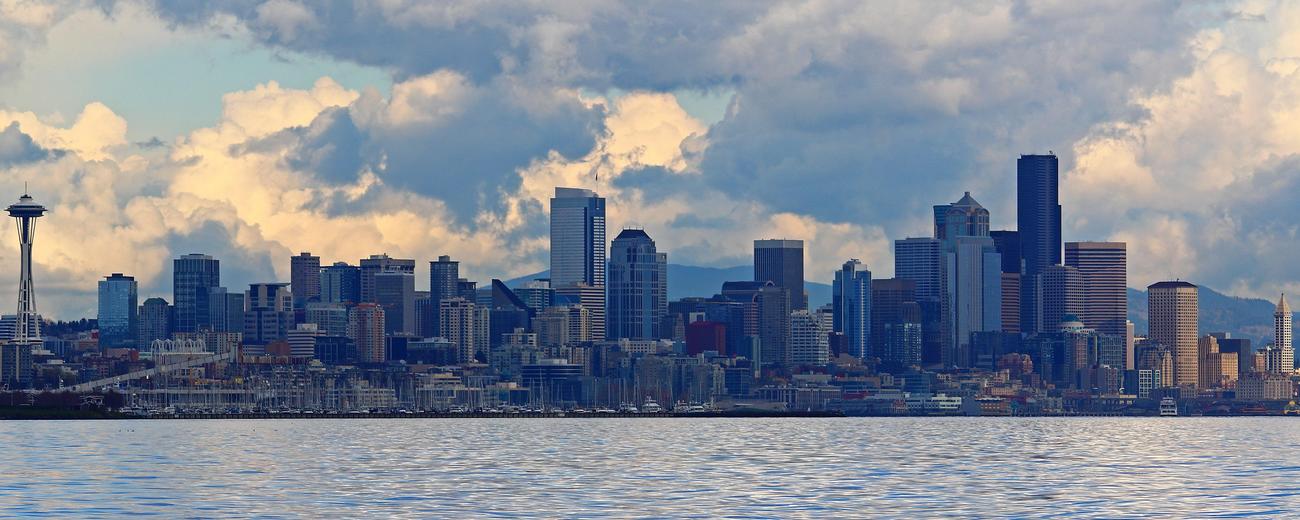





Seattle, Washington's largest city, is an amazing city with many different neighborhoods and districts culminating to create one of the Pacific Northwest's most culturally well-rounded cities. Take a moment to look through the information below to gain a better idea of the city's layout and where to spend your time during your visit.
Overview
Most visitors head down to the water and pay a visit to some of the famous Seattle sights. Pike Place Market, where fishmongers sing their way through your fish order, has gained notoriety worldwide. In this, the heart of downtown Seattle, fruit vendors hawk their wares in street-side shops, rubbing elbows with bagel-delis, cafés and Irish pubs. For sights and smells, this is it. If you'd rather have the sights without the smells, the Seattle Art Museum has a variety of offerings for the artistic palette while the discerning ear can enjoy a performance by the Seattle Symphony at Benaroya Hall, well worth the ticket.
A short walk down the hill from the market is the waterfront proper. Lounge on the grass at Waterfront Park and watch ferries pulling in and out of the Washington State Ferry Terminal or throw a line in at the public fishing pier, a few blocks north of the park. Stop in first at the Seattle Marine Aquarium and Omnidome for a look at some sea-life, in case you don't catch any of your own.
Seattle's former NBA team, the Supersonics, used to call Key Arena in Seattle Center their home court. Though "We Will Rock You" plays here no longer, the area still draws crowds to the Pacific Science Center, Experience Music Project, Opera House, Children's Museum and Seattle's symbol, the Space Needle. Take the elevator up to the Needle's observation deck to enjoy views from 520 feet above the city and have dinner in the revolving restaurant for 360 degrees of Seattle served right at your table.
A few blocks to the northeast are the southern shores of Lake Union, which serves as a conduit for traffic passing from the Puget Sound into Lake Washington. The area is notoriously trendy. Do some people watching in Gasworks Park on the north shore, where old industrial buildings have been incorporated into playground equipment. Bike, walk, or run the Burke-Gilman Trail, 24 miles of paved path that ends in Marymoor Park.
Residents of Capital Hill have some of the most spectacular views of the city. Though the area is mostly built up with private homes, Volunteer Park sprawls for 44 acres through the region, a pleasant place to stroll. Stop in at the Seattle Asian Art Museum for a sampling of Seattle's rich cultural heritage.
For a bigger stretch of natural space, head to Discovery Park west of Lake Union on the Puget Sound. When the picnic is over, watch boats come and go through the Hiram M Chittenden Locks. Here sea-going vessels leave the salt-waters of the Puget Sound for Lake Washington over Lake Union. Commercial fishermen dock at the Fisherman's Terminal, on the channel between Lake Union and the locks.
Directly across the Chittenden Locks from Discovery Park is an area once predominantly Scandinavian. Today, Ballard and Shilshole Bay see a fair share of cultural mixing. Visit the Nordic Heritage Museum for some Seattle history, and then wander along the marina for more ships in from sea.
If all this time by the water has you hoping for the chance to get your toes wet, head due east to Green Lake for a swim. If things get a little crowded with boaters and bikers and skaters and swimmers in summer, put it all in perspective with a trip to Woodland Park Zoo next to the lake.
The University of Washington campus is between Lake Union and Lake Washington, northeast of downtown Seattle. A thriving collegiate populous frequent the area's cheap - and varied - eats. Find pizza, used music stores and bars that cater to student budgets, a sharp contrast to downtown Seattle. Check out the Burke Museum for an anthropology lesson and the Henry Art Gallery for edgy art. Just south of the campus in Washington Park is the University of Washington Arboretum with carefully cultivated displays of regional plant-life. At the far end of the Arboretum is the Japanese Tea Garden complete with authentic tea house. Stop in for a look at the serenely beautiful ponds and groomed landscape.